
and {0} others
and {0} other
An eight-week pilot in the Marineterrein innovation district brought together students from vocational, higher vocational, and university programs, as well as independent students, in a single space. The goal was to explore and bridge the boundaries between art, science, and technology. While Amsterdam is working hard to become a leader in responsible technology, this pilot offered a concrete preview of what happens when the city’s future residents truly collaborate. Not to ask what technology can do, but to critically examine what it should do. Where the conventional education system often stops, four institutions instead created an open space for dialogue and connection. Together, the students challenged the status quo.
How can we make social media a safe place for teens again? Can an algorithm really understand subtext the way a human does? What will be left of us if everyone knows everything about each other? And can we reinvent the internet without a profit motive?
These were the questions shared by groups of students who normally lead completely separate lives: coders from Codam, artists from the Amsterdam University of the Arts, vocational students from the ROC van Amsterdam-Flevoland, and academic researchers from the MSc MADE program (AMS Institute/TU Delft/WUR). Over the course of six sessions, they came together at the Marineterrein for the Ethics, Art, Tech & Bildung pilot—a collaboration between the Open Knowledge Coalition, the Peer Academy, and the Bildung Academy.
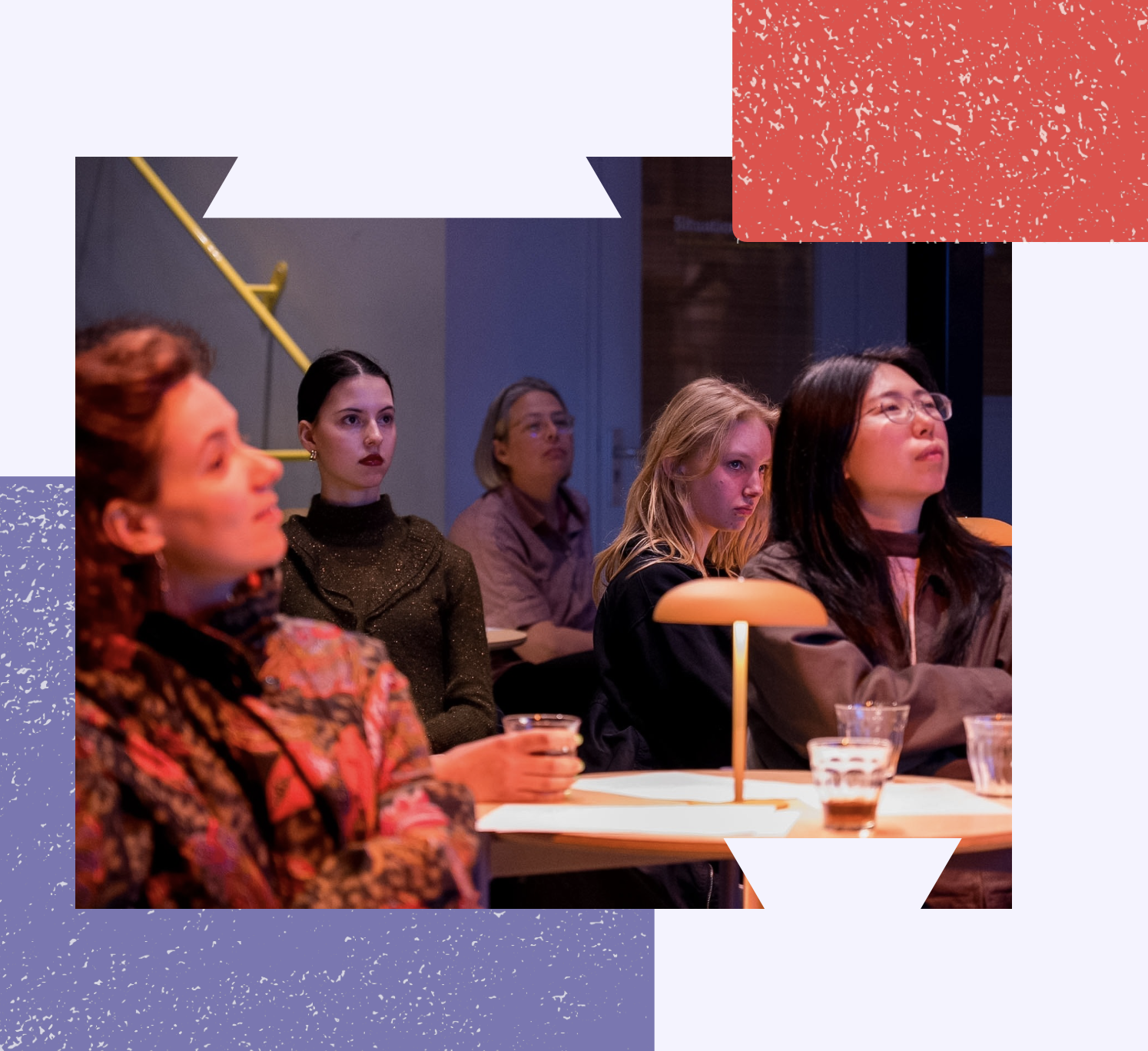
A Glimpse into the Kitchen: Design Sessions
Depolarization Through Encounter: As we worked toward a final presentation, each evening a complex social issue was paired with a guest speaker and a series of interactive exercises. No passive lectures, but active learning. In the first sessions, the groups engaged in dialogues to examine their own assumptions about “technology.” During a session with guest facilitator Aminata Cairo , the boundaries were pushed even further: students looked each other in the eyes continuously for a minute, held each other’s hands, and had genuine conversations. It was precisely these “unusual,” human moments that left the deepest impression.
That initial unease laid the foundation for a space where radically nuanced conclusions were allowed to exist. A master’s student who was stuck in a pessimistic echo chamber regarding surveillance technology noticed that his gloomy outlook softened simply by sitting at a table with students who, on the contrary, view AI and social media with enthusiasm. His silo was broken down, and the connections he made continue to foster a more hopeful vision of the future to this day.
How do you bring students from completely different backgrounds up to the same level in just a few weeks? Through the subject matter. After all, there’s no hierarchy in ethics; no one is in charge. An ethical issue directly touches on who you are as a person, which means that theoretical frameworks or programming skills suddenly no longer tip the scales. Because does your academic title even matter when the question is whether we’re allowed to film strangers in a public square without permission?
"It's more about engaging as a person than as a student." – an MSc MADE student at AMS Institute
"It's awesome to completely change someone's mindset with a project like this." – Arda, a student at ROC van Amsterdam-Flevoland
The most important factor driving this dynamic was the location. At the Marineterrein, the institutions are physically close to one another, which makes it easy for the organizers to connect with one another. Matthijs ten Berge (Amsterdam University of the Arts) observed that this physical proximity drove collaboration from the very beginning. “It’s also the fact that we’re a bit like an island here, so we have to figure out how to learn together, how to work together, and how to live together.” – Matthijs ten Berge, Amsterdam University of the Arts, and “For me, this wasn’t a class. You come here voluntarily, and honestly, I wouldn’t go to school voluntarily. I came here because I was curious.” – a student from ROC van Amsterdam-Flevoland.
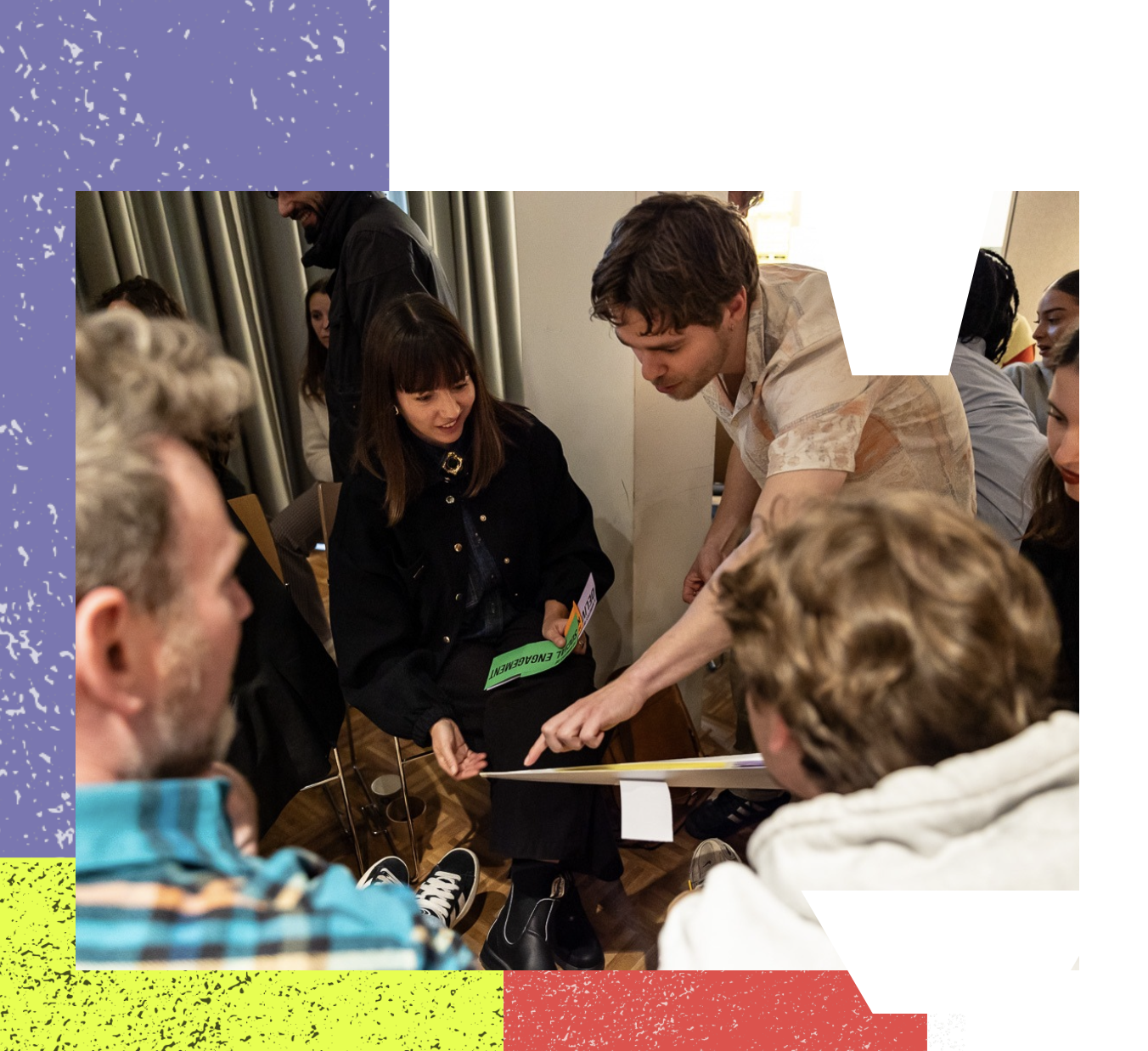
Learning to Deal with Uncertainty
A first pilot inevitably presents challenges, and that’s to be expected. The lack of a clear evaluation framework for the final showcase sometimes caused confusion among students who are used to fixed structures.
That is exactly what traditional education rarely asks of students, emphasizes Jenny Trimp (Peer Academy). “Over the course of the weeks, I saw their autonomy grow. Students began to speak up about their own needs and took charge of their projects. That’s a great achievement. Vocational students are still too often overlooked in these kinds of social debates, and that’s a shame. Technology is their future, too. Here, they not only learned about tech but also developed essential skills: collaborating constructively, presenting persuasively, and exploring their own opinions.”
"You get the chance to prove yourself. You're the one standing in front of the audience, the one who has to make your voice heard. That's different from a regular class, where you just listen. I've learned that giving a presentation isn't scary at all." – Israe, a student at ROC van Amsterdam-Flevoland
"I thought I would be able to apply a lot of my expertise. To my surprise, that didn't matter here at all. It was really more about me." – a student in the MSc MADE program at AMS Institute
Differences of opinion weren’t swept under the rug, but were used to sharpen their thinking. When an anonymous Codam student refused to join the group WhatsApp chat for privacy reasons—“which is rather strange in a course centered on ethics and tech”—the entire group immediately switched to Signal. While designing their showcase, the group challenged one another: how far can you go ethically to make your point? They decided not to disclose the secrets that visitors had shared in confidence; the ethical discussion thus became part of their own process. Another group was divided between tech pessimists and tech optimists. Instead of seeking a weak compromise, they built the disagreement directly into the core of their project.
The Final Showcase: Theory Meets Practice
During the closing night, the audience—a mix of friends, family, and education professionals—was directly involved in the students’ experiments. One group asked visitors to anonymously write down their name and a secret upon arrival. Those who agreed were given the name of a complete stranger a short time later, along with the task: find out online who this person is. It really hit home when it became clear how quickly a stranger could uncover someone’s entire, personal Pinterest board showcasing their interior design and fashion tastes. The feeling of suddenly being so exposed to a stranger immediately got the audience thinking.
A second group explored the boundary between humans and machines. They had the audience draw the concept of “love” by hand, to compare it directly with images generated by an AI. This confronted the audience with the question: What does our physical presence still add in a digitized world? A third group completely reversed the roles in education with an interactive meme quiz. While the adults in the audience tried to decipher online culture, they were graded by 16- to 18-year-old vocational students. The clear message to parents: Stop judging your child’s online world, but stay curious and engage in conversation.
The next step
We cannot simply shelve this pilot project. Technology is evolving faster than our ability to assess its ethical impact, while the tendency to pigeonhole people based on their level of education remains persistent. A young generation that breaks down these barriers and learns to live, work, and think together is of great value.
"As a society or as individuals, we very rarely stop to consider whether the way we use technology is actually the right way. That is exactly what we did during the course." – a student in the MSc MADE program at AMS Institute
"Society tends to view students in vocational education, higher professional education, and university education as very different. But it shouldn't be that way. They work together perfectly."
– Sillah, a student at ROC van Amsterdam-Flevoland
This pilot has proven that it can be done. Four institutions with completely different educational cultures gave students the tools to collaboratively design concrete alternatives to complex societal challenges. At the intersection of art, technology, science, and ethics, this program demonstrated that education should be about social development, not just about earning a degree. The most important question that remains now is: how do we ensure that this does not remain an isolated project, but is embedded in the DNA of every curriculum? That is the challenge the Open Knowledge Coalition will tackle.

Would you also like to establish a unique partnership with us and make it a lasting part of our organization? Let’s work together to build the future of education. Please contact info@debildungacademie.nl
About the Partners
The Bildung Academy is a bottom-up educational initiative founded by students and faculty members who were dissatisfied with what the mainstream education system was failing to provide. We believe in “Bildung”: an education that shapes you into a socially engaged individual who thinks critically, acts with empathy, and can weigh moral questions. With us, it doesn’t stop at talk; students translate their insights directly into tangible social projects.
The Open Knowledge Coalition is a long-term partnership between three educational institutions on the Marineterrein: the Amsterdam University of the Arts, Codam Coding College, and AMS Institute. Together, they are transforming the site into an innovation district where art, technology, and science converge. For this specific pilot project, they joined forces with the Peer Academy and De Bildung Academie.
Codam Coding College breaks with traditional structures. As a tuition-free software engineering school in Amsterdam (part of the global 42 network), Codam operates without teachers, without classrooms, and without fixed schedules. The curriculum is based entirely on peer-to-peer review and is open to anyone 18 years of age or older, regardless of prior education.
AMS Institute (Amsterdam Institute for Advanced Metropolitan Solutions) is the research institute founded in 2014 by TU Delft, Wageningen University & Research, and MIT. They use the city of Amsterdam as a living labto design solutions for pressing urban challenges. The participating students were enrolled in the joint MSc MADE master’s program.
The Amsterdam University of the Arts serves as a hub for talent across the entire cultural sector, comprising six academies: the Conservatorium van Amsterdam, the Netherlands Film Academy, the Academy of Theater and Dance, the Reinwardt Academy, the Academy of Architecture, and the Breitner Academy. At the Marineterrein, they drive innovation through the AHK Culture Club.
The Peer Academy (part of the ROC of Amsterdam-Flevoland) puts vocational students in charge of their own development. They are trained as Peer Educators, Peer Coaches, or Impact Makers to help shape their education. As equal partners, they tackle social issues that directly affect young people, from mental resilience to social safety.
The Bildung Academy would like to express its sincere gratitude to everyone who made this pilot possible.


